


In the context of rapidly increasing logistics costs, FIBC bags (Flexible Intermediate Bulk Containers), also known as Jumbo Bags, are becoming an optimal packaging solution for many industries such as animal feed, fertilizers, chemicals, and construction materials. With a capacity ranging from 500 kg to over 2,000 kg, these bags help businesses significantly reduce transportation and labor costs.
However, in reality, many companies are using FIBC bags incorrectly without realizing it. These mistakes not only increase operational costs but also pose significant risks to safety and cargo loss.
Below are the 5 most common mistakes that businesses should pay special attention to.
1. Choosing the wrong Safe Working Load (SWL)
One of the most serious mistakes is using bags that do not match the designed load capacity. Each FIBC bag has a clearly defined Safe Working Load (SWL), but many businesses choose based on assumptions or cost-saving intentions.
Consequences of overloading include:
- Bag stretching and deformation
- Bottom tearing or bursting
- Spillage of goods, causing direct losses
In some cases, overloading can also lead to workplace accidents during lifting operations.
Solution: Always check the technical specifications and choose a bag that matches the actual load. Avoid “gambling” with excess loading.
2. Ignoring the Safety Factor (SF)
Many businesses focus only on load capacity and overlook the Safety Factor (SF), which determines the overall strength of the bag.
Typically:
- SF 5:1 → Single-use bags
- SF 6:1 → Reusable (with proper inspection)
Using bags with an incorrect safety factor increases the risk of failure during lifting, especially in continuous or heavy-duty operations.
This is a “silent” but extremely dangerous mistake because it is not easily visible.
Solution: Train staff to understand the importance of SF and clearly classify bags based on usage purposes.
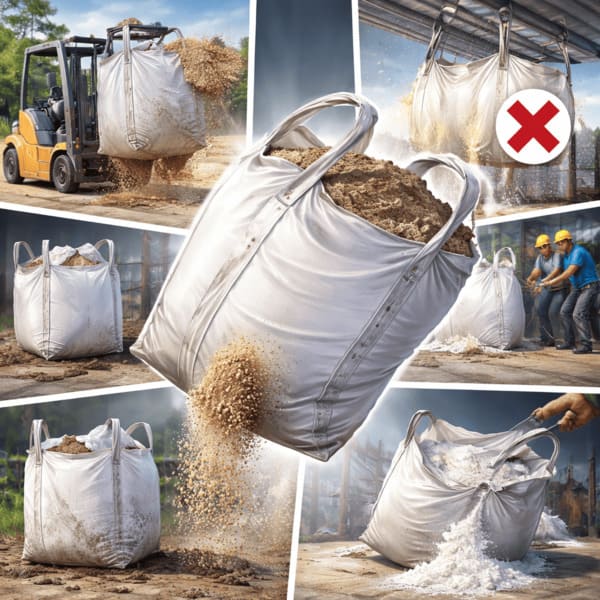
3. Using the wrong lifting loops
FIBC bags come with various types of lifting loops, such as:
- Single loop
- Two loops
- Four loops
- Cross-corner loops
Each type is designed for specific handling methods (forklifts, cranes, etc.). However, many businesses use the wrong type or attach them improperly.
Consequences include:
- Imbalanced lifting
- Increased risk of dropping goods
- Higher risk of workplace accidents
In large-scale operations, even a small mistake can cause significant chain damage.
Solution: Standardize lifting procedures and select the correct bag type compatible with existing equipment.
4. Improper storage of FIBC bags
FIBC bags are typically made from polypropylene (PP), which is durable but sensitive to environmental factors, especially:
- Sunlight (UV exposure)
- High humidity
- Temperature conditions
Many businesses store bags outdoors or in humid environments for extended periods, leading to material degradation.
Consequences:
- Increased risk of tearing during use
- Reduced lifespan
- Higher replacement costs
Solution:
- Store in dry, well-ventilated areas
- Avoid direct sunlight
- Use UV-protected bags for long-term storage
5. Reusing bags without inspection
To save costs, many businesses choose to reuse FIBC bags. However, the issue lies in not inspecting the bags before reuse.
Common problems include:
- Worn or frayed lifting loops
- Weakened bag bottom after repeated use
- Small tears that go unnoticed
Continuing to use such bags may result in sudden failure, causing significant product loss.
Solution:
- Only reuse bags with SF 6:1 standard
- Inspect carefully before each use
- Immediately discard damaged bags
Why do businesses still make these mistakes?
The main reasons are not technical but stem from:
- Lack of expertise in FIBC usage
- Absence of clear packaging management processes
- Short-term cost-saving mindset
Meanwhile, the actual losses are often far greater than the initial investment cost.
Conclusion: Do it right from the start for long-term savings
FIBC bags are an extremely effective solution when used correctly. On the contrary, even small mistakes can cost businesses hundreds of thousands annually due to losses, damage, and increased operational costs.
To optimize efficiency, businesses should:
- Choose the right type of bag (load capacity, SF, design)
- Train staff to follow proper procedures
- Strictly control storage and reuse
Investing in proper FIBC usage not only reduces costs but also enhances professionalism and safety throughout the entire operation chain.